
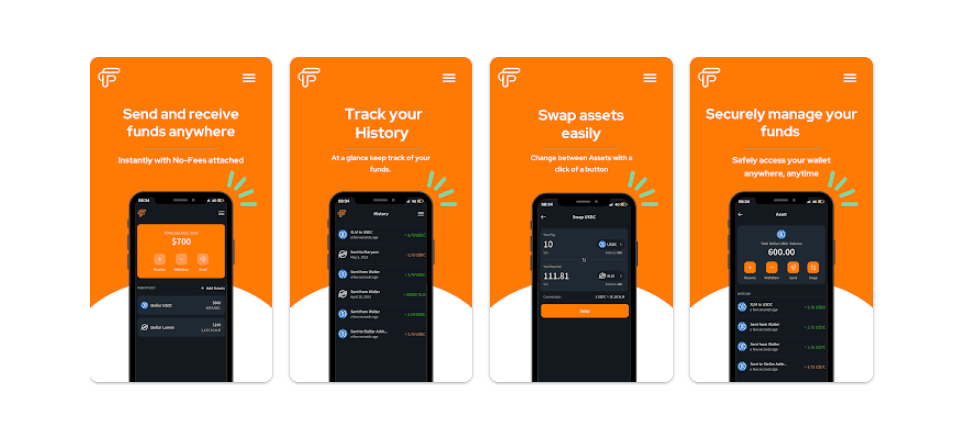
The fastest way for a fintech or NGO to launch a branded USDC wallet is to license one. The buyer supplies a name, logo and colors and picks the stablecoins and cash-in and cash-out services it needs. With BP Ventures, the web wallet goes live and the iOS and Android apps are submitted to the stores within one to two weeks of receiving the branding.
Building in-house remains an option. It suits teams whose product or custody model is unusual enough that no vendor fits.
BP Ventures sells a white-label stablecoin wallet, and this guide reflects that. It is written for buyers in emerging markets, where moving money between the wallet and local cash takes more work than building the app.
BPV built Freedom Pay Wallet, which a UK charity uses to pay beneficiaries in The Gambia and Tanzania in USDC. Recipients can withdraw cash at more than 400,000 MoneyGram locations worldwide.
What a white-label stablecoin wallet is
A white-label wallet is a finished product sold under the buyer's name, logo and app-store listing. The buyer owns the customer relationship. The vendor runs the software, the blockchain integration and the upgrades.
End users see only the buyer's brand. They hold USDC or another stablecoin, send it, swap it and convert it to local cash.
Build vs white-label
| Build in-house | White-label | |
|---|---|---|
| Time to launch | Months: chain integration, key management, ramps, three app platforms, security review | 1–2 weeks with BPV |
| Upfront cost | Engineering team plus audits | One-time setup fee |
| Ongoing cost | Team retained for maintenance and upgrades | Monthly maintenance and support fee |
| Fiat rails | Negotiated and integrated one by one | Pre-integrated |
| Key management | Designed and audited by you | Provided |
| Control | Full | Within the vendor's product |
Building makes sense when the wallet is the business and its roadmap departs from what vendors offer. A remittance service, a payroll provider or a charity paying beneficiaries uses a wallet as a channel, and for them a custom build usually costs more than it returns.
Custody: custodial vs non-custodial
In a custodial wallet the provider holds the keys and users trust it the way they trust a bank. In many jurisdictions, holding customer assets brings licensing and safeguarding obligations.
In a non-custodial wallet each transaction is signed with the user's key, and the provider cannot move funds on its own.
Non-custodial wallets used to depend on seed phrases, and users who lost theirs lost their money. Stellar's SEP-30 recovery standard removes that dependency. The user's account adds independent recovery servers as signers, set up so that no single server can move funds. A server signs only after the user proves their identity, for example by signing in with Google, Apple or email. A user who replaces a phone can recover the account that way.
BPV offers only the non-custodial model. To keep it that way, the wallet does not run identity checks itself. Know-your-customer (KYC) checks are carried out by the regulated firm that converts the money: a money-service business such as MoneyGram, or an anchor running BPV's Anchor in a Box software.
Regulation depends on more than custody. Payments, identity checks, on- and off-ramps and each market's rules carry their own obligations. Buyers should take local legal advice before launch.
Which stablecoins, which chain
The BPV wallet runs on Stellar and supports USDC, USDT, PayPal's PYUSD and Bitcoin Lightning.
Stellar transactions settle in seconds, and network fees are fractions of a cent. BPV pays those fees, so users never need to hold a separate token for gas. Ramp, foreign-exchange and card partners may still charge their own fees.
Stellar also connects to anchors, regulated firms that exchange stablecoins for local currency. For a wallet serving emerging markets, that network counts for more than transaction speed.
Fiat rails: getting money in and out
Users need to fund the wallet with local money and to spend or withdraw it as local money.
The BPV wallet is pre-integrated with:
- MoneyGram for cash deposits and withdrawals at its locations. See our MoneyGram integration.
- Bridge and OwlPay for bank deposits and withdrawals.
- Apple Pay, ACH, SEPA Instant and PIX, depending on the ramp partner.
- A prepaid Visa card, bill payments and mobile top-ups.
Availability depends on the buyer's country, its users' corridors and each partner's approval of the business. Buyers should map their corridors before choosing a vendor.
How long it takes to launch
The clock starts when the customer delivers branding and chooses assets and rails. It stops when the web wallet is live and the apps are submitted to Apple and Google. With BPV that takes one to two weeks, in five steps:
- Kickoff: agree assets, rails, markets and languages.
- Branding: name, logo, colors and app-store copy.
- Configuration: assets, ramps, and whether to show crypto at all or only US dollars or local currency.
- Build and test: branded web, iOS and Android versions.
- Submission: the web wallet goes live and the apps go to the stores.
Two steps fall outside that window. Apple and Google set their own review times, and ramp partners run their own onboarding and compliance checks on the buyer. A custom build typically takes months.
What it costs
BPV charges a one-time setup fee and a monthly maintenance and support fee, and covers network fees. Ramp, foreign-exchange and card partners bill separately.
Other vendors may charge per active user, per transaction or a share of revenue. The checklist below sets out what to ask.
The vendor landscape
Vendors fall into three groups, listed here in no particular order.
Enterprise custody and infrastructure, for institutions that hold assets or build their own product on top:
- Fireblocks: wallet and custody infrastructure for institutions.
- Circle Digital Asset Accounts: Circle-custodied USDC and EURC accounts that fintechs and platforms offer to business customers. Launched in March 2026.
- OSL: Hong Kong digital-asset group offering stablecoin payments infrastructure, including embedded wallets.
White-label wallet, banking and payments platforms, from full digital banks to single components:
- Crassula: white-label banking platform with crypto wallet modules.
- FinHost: white-label digital banking platform with crypto and fiat wallets.
- Kresus: white-label wallet infrastructure that can run as custodial, non-custodial or hybrid.
- Fideum: embedded crypto infrastructure for banks, brokerages and payment providers.
- Utorg: on- and off-ramps and payment rails, with white-label wallet infrastructure.
- Inyo Global: money-movement platform offering white-label stablecoin wallets, with compliance handled by Inyo.
- Mesta: fiat and stablecoin payment rails with a white-labeled customer portal.
- Kulipa: stablecoin card issuing for wallets and fintechs.
- Polygon ecosystem wallets: wallet builders on Polygon and other EVM chains.
Development agencies, which build to specification:
- ND Labs and Pixel Web Solutions: crypto wallet development firms.
BPV belongs in the second group. Its wallet is non-custodial, built on Stellar and pre-integrated with fiat rails that reach emerging markets. A charity runs it in production.
BPV at a glance
| BPV white-label wallet | |
|---|---|
| Custody | Non-custodial only |
| Chain | Stellar |
| Assets | USDC, USDT, PYUSD, Bitcoin Lightning, LTC |
| Platforms | Web, iOS, Android |
| Recovery | SEP-30, via Google, Apple or email; no seed phrase |
| Languages | English, Arabic, French, Portuguese, Spanish, Turkish, Hindi, Urdu, Bahasa Indonesia, Mandarin (simplified) |
| Identity checks (KYC) | Run by the anchor (via BPV's Anchor in a Box) or the money-service business, such as MoneyGram |
| Network fees | Paid by BPV |
| Fiat rails | MoneyGram, Bridge, OwlPay, prepaid Visa, bill payments, mobile top-ups |
| Launch | Web wallet live and apps submitted within 1–2 weeks of receiving branding |
| Partner onboarding | Run by each ramp partner, outside the launch window |
| Fees | One-time setup fee plus a monthly maintenance and support fee |
Buyer checklist
- Who can move funds, and how does a user recover a lost phone?
- Which stablecoins are supported, on which chains?
- Which on- and off-ramps work in your corridors today?
- Who runs identity checks, and who owns the customer data?
- Does recovery rely on a seed phrase, social login or something else?
- Does the wallet ship in your users' languages?
- Who pays network fees?
- When does the launch clock start, and what ends it?
- What are the setup, monthly, per-user and per-transaction fees?
- Can you move your users and data to another vendor?
Case study: Freedom Pay Wallet
Freedom Pay Wallet is a non-custodial Stellar wallet that BPV built for the Freedom Development Foundation, a UK charity working in The Gambia and Tanzania. It runs on the Stellar Disbursement Platform.
Beneficiaries receive USDC. They can withdraw cash at MoneyGram, pay electricity bills, top up phones or buy gift cards for groceries. A 2025 upgrade added the bill payments, gift cards and top-ups. Sign-up and recovery use SEP-30, with no seed phrase.
The project won Stellar Community Fund #38 in 2025 and is listed on the Stellar Community Fund site. The app is on the App Store. It was one of six stories in the Made to Move exhibit at Stellar Meridian 2026 in Lisbon.
"Thank you for building such an empowering wallet, especially for charities! I highly recommend the BPV team, competent, knowledgeable and honest." — Freedom Pigott
FAQ
How do I launch a branded USDC wallet for my fintech?
License a white-label wallet, supply your branding and choose your assets and fiat rails. The vendor builds the branded web and mobile versions and submits the apps to the stores.
How long does it take to launch a white-label wallet?
With BPV, one to two weeks from receiving branding to a live web wallet and apps submitted to the stores. App-store review and ramp-partner onboarding follow on those partners' timelines. A custom build typically takes months.
What is the best white-label crypto wallet for a fintech?
That depends on the custody model and the corridors. Firms that want to hold customer assets should look at custodial infrastructure. BPV's non-custodial Stellar wallet is built for firms whose users hold their own funds and need fiat rails in emerging markets.
Is a non-custodial wallet regulated?
Custody alone does not decide it. A non-custodial provider holds no customer funds, but payments, identity checks, ramps and local rules can still apply. In BPV's model, the anchor or money-service business that converts the money runs the identity checks. Take legal advice for each market.
Can I hide crypto and show only US dollars or local currency?
Yes. The BPV wallet can launch showing only US dollars or local currency, with a map of cash pickup and payment locations.
Next step
See the white-label stablecoin wallet, or book a call to scope a launch.