
Terrorists. Gamblers. Russian sanctions evasion.
Ask why banks spent a decade avoiding stablecoins and some version of that list is what comes back. The list isn't even wrong. Stablecoins account for roughly 84% of illicit crypto transaction volume. A single ruble-backed stablecoin, A7A5, tied to Russia's A7 network — not USDT or USDC — processed $93.3 billion in about 10 months according to Chainalysis, as a settlement rail for sanctioned Russian trade. Value received by sanctioned entities rose 694% in 2025.
None of it is the reason.
One thing held back stablecoin adoption more than every compliance concern combined, and it never made a headline — because it isn't a scandal. It's a number in a prudential rulebook that almost nobody outside bank treasury has read.
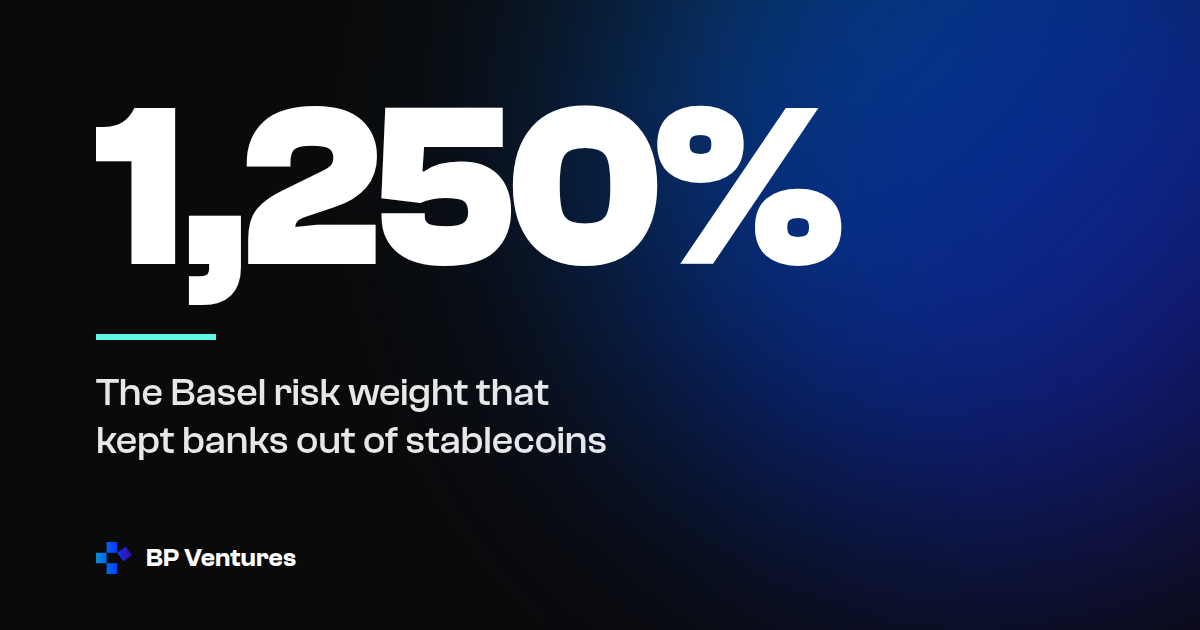
1,250%.
That is the risk weight a bank must apply to a Group 2b cryptoasset exposure. In practice it means a bank holding $100 of USDC must hold roughly $100 of capital against it — the treatment the Basel framework reserves for its most punitive cases. No compliance committee ever had to say no, because the capital desk had already killed it. Nobody was ever going to build a payments business on that.
The usual explanation for slow adoption is that banks are slow. That's lazy. The real answer is that until about eighteen months ago, a bank that wanted to touch a stablecoin faced a capital charge that made it uneconomic, a liquidity rule that made the reserves useless, an accounting bulletin that made custody a balance-sheet event, and a supervisor who wanted a permission slip first. Every one of those has now moved. Here is the actual list, ranked.
One thing to fix first, because it decides which rules are worth reading. About 99.5% of the stablecoin market is dollar-denominated — roughly $308 billion outstanding, of which euro-denominated tokens account for $848 million, or 0.28%. So this is a dollar story. The instruments that govern it are American and Basel ones, and European consortium announcements, however many banks sign them, are not where the question gets settled.
1. Capital and liquidity: SCO60 is the binding constraint
This rule comes out of Basel, Switzerland — so, the gnomes of Zurich.
And their colleagues at the Federal Reserve. The Basel Committee on Banking Supervision has 45 members across 28 jurisdictions, and the United States holds four of those seats: the Federal Reserve Board, the Federal Reserve Bank of New York, the OCC and the FDIC. It is hosted by the BIS but legally separate from it. Which means the American agencies helped write the standard that made stablecoins uneconomic for American banks — and then, in 2025, spent the year dismantling their own domestic obstacles to the same activity.
The Basel Committee's cryptoasset standard, SCO60, came into force in the Basel Framework on 1 January 2026. Its central judgement is the one that matters for stablecoins: an asset recorded on a public, permissionless blockchain cannot meet the Group 1 classification conditions — the tier that receives something close to normal capital treatment.
USDC and USDT live on permissionless chains. So they fall out of Group 1 into Group 2, where treatment runs up to the 1,250% risk weight applied to the greater of aggregate long or aggregate short positions, with hedging not recognised. On top of that sits a concentration limit: Group 2 exposures should generally not exceed 1% of Tier 1 capital, and once the book reaches 2%, all Group 2 exposures take the punitive Group 2b treatment.
The liquidity rules add a second penalty that gets far less attention and may matter more. Under OSFI's implementation, a stablecoin held on the balance sheet is non-HQLA, attracts at least an 85% RSF factor in the NSFR, and generates no LCR inflows. Worse, funding received from a stablecoin issuer — the reserve deposits, the thing banks supposedly want — is treated as an exposure to a financial institution: no stable funding credit in the NSFR and a 100% run-off factor in the LCR.
Read that again, because it is the quiet core of the whole story. A bank taking stablecoin reserves must assume the entire balance walks out the door within thirty days. Reserves that behave that way cannot fund lending. The most obvious bank-friendly stablecoin business — hold the reserves, earn the float — was regulatorily defunded before it started.
This is now being revisited. The Committee announced a targeted review in November 2025; industry bodies including GFMA, ISDA, FIA and the IIF petitioned for recalibration in August 2025; and at its 24–25 February 2026 meeting the Committee said the review was progressing, with an update due later in 2026. That update has not landed. Note the timeline: SCO60 came into force already under revision. The United States has signalled it will not implement the standard as written. The EU has been running a transitional regime under Article 501d of CRR 3 since 9 July 2024, with the EBA's final draft RTS under Article 501d(5) published on 5 August 2025 and a 1% Tier 1 limit on "other crypto-assets."
2. The deposit franchise and net interest margin
Banks do not principally make money moving money. They make it holding money cheaply and lending it dearly. A stablecoin is a claim on a dollar that lives somewhere other than a bank.
Citi Institute puts stablecoins outstanding at $0.5–3.7 trillion by 2030, displacing $182–908 billion of bank deposits. The full US transactional deposit base — roughly $6.6 trillion — has been named as the theoretical exposure, though that is an addressable-market figure, not a forecast.
The evidence is genuinely contested. In April 2026 the White House Council of Economic Advisers found that prohibiting stablecoin yield would raise bank lending by just $2.1 billion — about 0.02% — while costing consumers roughly $800 million a year in forgone returns. The American Bankers Association replied that the CEA had "studied the wrong question": the issue isn't modelling a ban, it's what happens when yield-bearing stablecoins scale, and the pain lands on community banks' funding costs and their lending to small businesses and farmers.
Cross-border, the threat is to fee income rather than to deposits. Stablecoin flows bypass the correspondent chain entirely — no nostro or vostro accounts, no intermediary banks, no multi-day settlement — and with it the FX spread and float that make the corridor profitable. On the worst corridors that spread is not small: Sub-Saharan Africa averages 8.37% all-in, through two to four intermediaries.
3. Until 2025, US supervisors simply said no
This is probably the single largest explanation for the American timeline, and it is the most concrete.
SAB 121, issued by the SEC in March 2022, required any entity safeguarding crypto assets for customers to recognise both an asset and a corresponding liability at fair value on its own balance sheet. For a bank, that gross-up carried regulatory capital consequences that made custody uneconomic at any serious scale. It was not a ban. It was worse than a ban, because it looked like a technical accounting choice.
SAB 122, issued 23 January 2025, rescinded it. Custodied assets now sit off balance sheet, with an ordinary loss-contingency assessment under ASC 450 / IAS 37. A firm holding $10 million of client crypto that previously booked a $10 million liability might now book only its modelled at-risk amount.
The banking-agency track moved in parallel. OCC Interpretive Letter 1179 (18 November 2021) required supervisory non-objection before a bank engaged in crypto activity. Interpretive Letter 1183 (7 March 2025) rescinded it outright, confirming national banks may provide custody, hold stablecoin reserve deposits, and conduct certain stablecoin and payment activities without asking first. Interpretive Letter 1184 extended this to execution and outsourcing in May 2025.
Separately, a House Financial Services Committee majority-staff report published 25 November 2025 argues that federal prudential regulators discouraged banks from serving lawful digital-asset businesses between 2021 and early 2025 through informal guidance, supervisory posture and enforcement — identifying at least 30 affected entities and citing "non-objection" and "pause" letters. It is a political document and the OCC responded to it; treat it as an allegation. SAB 121 and IL 1179 need no such hedging. They are published instruments with published rescission dates.
4. AML and sanctions — real, but not the binding constraint
Now back to the terrorists and the gamblers, because the point isn't that the risk is fake. It isn't. Those figures are from Chainalysis's 2026 Crypto Crime Report, total illicit volume hit $154 billion in 2025, and for a bank's financial crime function "most of it is fine" has never been an operating standard. The share of activity is small; the concentration is extreme; sanctions teams are judged on the tail, not the mean.
But notice what this section can't explain. It can't explain why banks would custody a fully-reserved, MiCA- or GENIUS-compliant dollar token issued by a regulated entity — a product with better transaction surveillance than correspondent banking, where the money passes through four opaque intermediaries. Compliance risk is manageable; banks manage worse every day. A 1,250% risk weight is not manageable. It is arithmetic.
That's the difference between a concern and a constraint, and it's why this section ranks fourth rather than first.
5. Privacy and confidentiality
A public ledger is a public ledger. GDPR, and Swiss and Singaporean banking secrecy regimes, treat transaction amounts, counterparties and purpose as protected information. Infrastructure providers report that for regulated banks and funds, confidentiality is now a deal-breaker rather than a preference — a barrier that has climbed the list as the others have fallen away.
6. Banks weren't only blocked. They were building the version they'd rather own.
This is the reason that reframes all the others, and it is missing from almost every version of this argument.
The GENIUS Act bars stablecoins from paying interest. A tokenised deposit has no such restriction. On 7 April 2026 the FDIC proposed that deposit insurance should not depend on recordkeeping technology — giving tokenised deposits the same $250,000 coverage as any other deposit. So the bank product is insured, can pay interest, stays on balance sheet, and preserves the customer relationship. The stablecoin is none of those things.
This is not theoretical. JPMorgan's Kinexys already processes more than $7 billion per day, with over $4 trillion settled since launch, and JPMorgan, Citi and Bank of America are working with The Clearing House on a shared tokenised-deposit network. Citi estimates tokenised deposits could support $100–140 trillion in annual flows by 2030.
A bank that ignored stablecoins for four years while building this was not being slow. It was being strategic.
(And then there is the plumbing. Core banking systems settle in business-day batches; public chains settle continuously. Reconciling an always-on external network against a batch core creates friction across finance, risk, operations and IT — which is why the emerging pattern is API-first middleware layered on top of the core rather than core replacement. There is no credible public data on what this actually costs. Anyone who quotes you a number is guessing.)
What actually changed
Not the technology. The technology worked in 2014.
What changed is that the accounting was rescinded (January 2025), the supervisors stood down (March 2025), the law arrived (GENIUS Act, MiCA), the capital standard came into force already under revision (January 2026), and the FDIC proposed making the bank-native version insurable (April 2026).
There has been a steady drumbeat of bank consortium announcements alongside all this — a 37-bank European group planning a MiCA-compliant euro stablecoin, 21 banks including Citi, Goldman Sachs and UBS forming a global consortium for H1 2027. Treat these as weather, not climate. Euro-denominated stablecoins total $848 million against a $308 billion market: 0.28%. A European euro consortium is a regional sideshow issuing into a rounding error, and none of it has shipped.
Which points at the thing that should have been said at the top. Roughly 99.5% of the stablecoin market is dollar-denominated. That single fact determines whose rules matter. This is not a global story with many jurisdictions pulling in different directions — it is a dollar story, which means it is a story about SAB 121, Interpretive Letter 1179, the GENIUS Act, and whatever Basel does next. Everything else is a press release.
Will this change? Five decisions still pending
Everything above rests on rules that are, right now, being rewritten. If you only track five things, track these.
1. The Basel SCO60 revision — the big one. The Committee announced a targeted review in November 2025, said it was progressing at the 24–25 February 2026 meeting, and promised an update later in 2026. As of this writing it has not arrived. If the permissionless-chain exclusion from Group 1 is relaxed, the 1,250% risk weight and the 1%/2% Tier 1 limits stop binding — and the central economic objection to bank stablecoin activity disappears in a single paragraph of revised text. Nothing else on this list matters as much.
2. The GENIUS Act yield loophole. The ban on stablecoin yield is what gives tokenised deposits their exclusive right to pay interest. But issuers have been routing rewards through affiliates and exchanges, and on 25 February 2026 the OCC issued a proposed rule establishing a rebuttable presumption that a coordinated arrangement between an issuer and an affiliate to pay holders yield is itself prohibited yield. Follow-on legislation may close it outright. If the loophole survives, the bank moat in section 6 is considerably narrower than it looks.
3. The FDIC's final rule. The tokenised-deposit proposal was approved 7 April 2026 and published in the Federal Register on 10 April; the comment period closed 9 June 2026, with the Bank Policy Institute, The Clearing House and the Consumer Bankers Association all filing. The final rule is outstanding. It is the legal foundation for the entire tokenised-deposit strategy.
4. The EU's permanent regime. Article 501d CRR 3 is explicitly transitional, intended to be replaced by a dedicated prudential regime for cryptoasset exposures. Whether that regime tracks a revised Basel or diverges from it will decide the economics for every bank in the single market.
5. Whether euro issuance scales at all. A minor item, listed because it is testable rather than because it is large. The 37-bank consortium's EMI licence is still pending at De Nederlandsche Bank, with launch contingent on approval. From 0.28% of the market, either MiCA-compliant bank issuance moves the euro segment or it confirms that this remains a dollar market with a European hobby attached.
Note the asymmetry, because it's the most interesting thing in this whole story. Basel relaxing the permissionless exclusion would make it economic for a bank to hold public-chain stablecoins on its own balance sheet. The OCC closing the yield loophole would make tokenised deposits the only interest-bearing digital dollar. Those two decisions push in opposite directions. Both are live right now. Whichever lands first shapes the next five years — and nobody, including the people making the decisions, currently knows which it will be.
So: will this change? It already is. The honest answer is that the rulebook that kept banks out is being rewritten while they're walking through the door, and the final text isn't written yet.
Which is a far better question than "why are banks so slow."